

PRECISION MEASUREMENT
OUTLINE

Searching for New Physics via Precision Measurement
Our group explores physics beyond the Standard Model—so-called "new physics"—by performing precision measurements of ultracold ytterbium (Yb) atoms.
Over the past decades, particle physics has advanced by directly producing particles using high-energy colliders, leading to the establishment of the Standard Model—a framework that successfully explains a wide range of phenomena in particle physics. However, key mysteries remain, such as the nature of dark matter and the matter-antimatter asymmetry in the universe. Addressing these open questions requires theories that go beyond the Standard Model, making the search for new physics a central challenge in the field. These open questions highlight the need for new physics beyond the Standard Model—a major challenge in modern physics.
In recent years, precision measurements using low-energy quantum systems—such as atoms, molecules, and ions—have received much attention as a complementary approach to high-energy experiments [1]. Advances in quantum technology have enabled exquisite control and measurement of quantum states, allowing certain quantum systems to serve as highly sensitive sensors for indirect detection of new physics.
Below are the research topics we are working on.
(01)
ISOTOPE SHIFTS
AND NEW PARTICLES
Search for a new particle with isotope-shift measurements

We search for new particles mediating forces between electrons and neutrons by precisely measuring the isotope shifts in optical transitions. The isotope shift shows a property known as King linearity, meaning that when the isotope shifts of two different optical transitions are plotted against each other, they lie on a straight line. However, if such a particle exists, this linearity would be violated. Therefore, testing King linearity at high precision enables an indirect probe of such particles [2]. Moreover, by examining the linearity among more than two transitions, it becomes possible to subtract higher-order contributions arising from the Standard Model, thereby enabling a more refined search for potential new physics.
Yb atoms are particularly well suited for this test because they possess five stable bosonic isotopes and multiple ultranarrow optical transitions, which allow for highly precise measurements of isotope shifts. We have performed precision-isotope-shift measurements of the ultranarrow 1S0↔3P0 and 1S0↔(4f)135d(6s)2 (J = 2) transitions, giving the constraints on the coupling constants [3,4]. Notably, for the first time, we were the first to directly observe the 1S0↔(4f)135d(6s)2 (J = 2) transitions and determined its magic wavelengths, which play a key role in precision spectroscopy in optical traps [5].
Currently, we are planning similar measurements using the radioactive isotope ¹⁶⁶Yb to explore potential higher-order effects. To this end, we are developing techniques for laser cooling of ¹⁶⁶Yb produced via accelerator-based methods.
This research aims to indirectly explore particles and interactions that have never been observed before.
Currently, we are planning similar measurements using the radioactive isotope ¹⁶⁶Yb to explore potential higher-order effects. To this end, we are developing techniques for laser cooling of ¹⁶⁶Yb produced via accelerator-based methods.
This research aims to indirectly explore particles and interactions that have never been observed before.
(02)
LORENTZ
INVARIANCE TESTS
Testing Lorentz invariance

Lorentz invariance is the principle that the laws of physics are independent of direction in the universe, and it constitutes a fundamental requirement of modern physics. A violation of Lorentz invariance would immediately indicate the existence of new physics beyond the Standard Model. According to extensions of the Standard Model that incorporate such new physics, violations of Lorentz invariance in the electron-photon sector can lead to tensor shifts that alter atomic energy levels [6].
In this study, we test Lorentz invariance by precisely measuring atomic energy level intervals and examining their directional dependence. Specifically, we focus on the magnetic sublevel intervals of the metastable (4f)135d(6s)2 (J = 2) state of Yb, which has been theoretically calculated to exhibit high sensitivity to Lorentz-violating effects [7]. This research is motivated by a profound question: Does the universe have a preferred direction?
(03)
NUCLEAR MQM SEARCH
Search for a nuclear magnetic quadrupole moment

Why is there an imbalance between matter and antimatter in the present universe? This fundamental mystery remains unresolved. One possible explanation involves a strong CP violation in the interactions between elementary particles—or, assuming the CPT theorem, a violation of time-reversal symmetry—which could have contributed to the formation of a matter-dominated universe. This idea aligns with one of Sakharov’s three conditions necessary for baryogenesis.
In light of this, many experimental efforts have been devoted to searching for CP violation. However, observed CP violation to date has not been sufficient to account for the observed matter-antimatter asymmetry. As a novel probe, we focus on the nuclear magnetic quadrupole moment (MQM), a quantity that violates both time-reversal and parity symmetries. The MQM manifests as a shift in the nuclear spin energy levels when electric and magnetic fields are applied, arising from its interaction with the magnetic field gradient generated by the motion of bound electrons within the atom. Furthermore, theory suggests that deformed nuclei—those deviating from spherical symmetry—exhibit enhanced sensitivity to MQMs [8]. We aim to search for the nuclear MQM in ¹⁷³Yb, which has a deformed nucleus, by preparing it in a long-lived electronic excited state ³P₂ theoretically predicted to generate a large magnetic field gradient. By measuring the difference in spin precession frequencies under electric fields applied parallel and antiparallel to the quantization axis, we can probe the presence of an MQM (experimental proposal [9]).
(04)
RYDBERG ATOMS FOR
DARK MATTER SEARCH
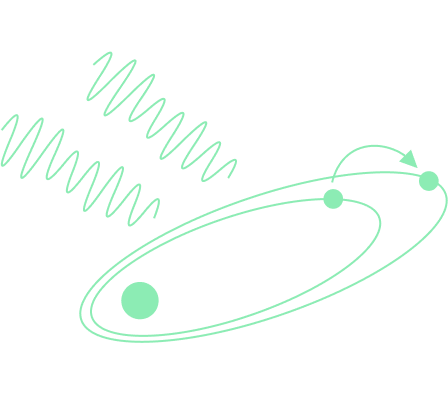
Search for dark matter using Rydberg atoms
Only about 5% of the universe consists of ordinary matter that we can directly observe. The remaining components are thought to be approximately 69% dark energy and 26% dark matter. Although dark matter cannot be detected via electromagnetic radiation, its existence has been inferred through astrophysical observations—such as the rotational velocity distributions of galaxies—as a form of matter that does not interact electromagnetically but does exert gravitational influence.
Among the various candidates for dark matter, we focus on dark photons, hypothetical particles that interact only with ordinary photons. In our research, we plan to use atoms in Rydberg states as quantum sensors for dark photon. A Rydberg state is an excited state in which the outermost electron occupies an orbital with a very high principal quantum number. Because the electron is far from the nucleus, these atoms have large electric dipole moments and thus are extremely sensitive to external oscillating electric fields, making them promising candidates for detecting the tiny oscillating electric fields induced by dark photon conversion.


FOR
UNDERGRADUATE
The Quantum Optics Group welcomes undergraduate students who are interested in visiting our group.